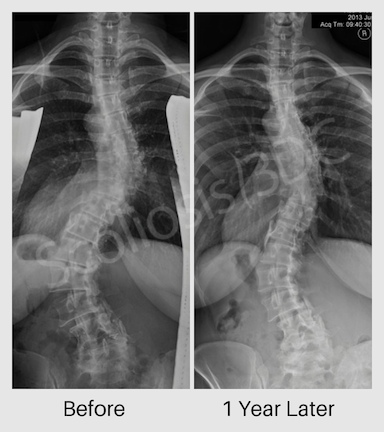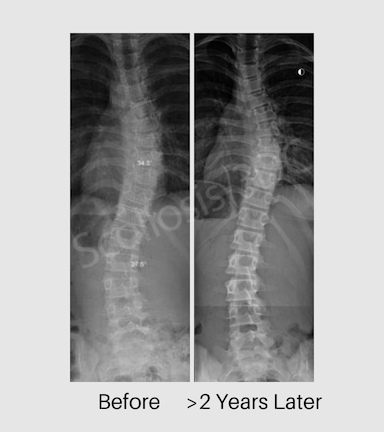


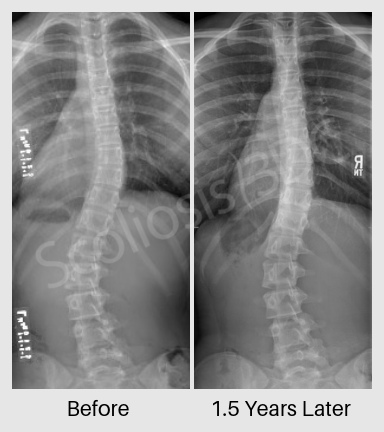
Result: TW
- 13-year-old female
- Initial Cobb angles 31º/34º
- Risser 3

A U.S. scoliosis treatment center offering the highly effective Schroth method and Cheneau Gensingen scoliosis brace.
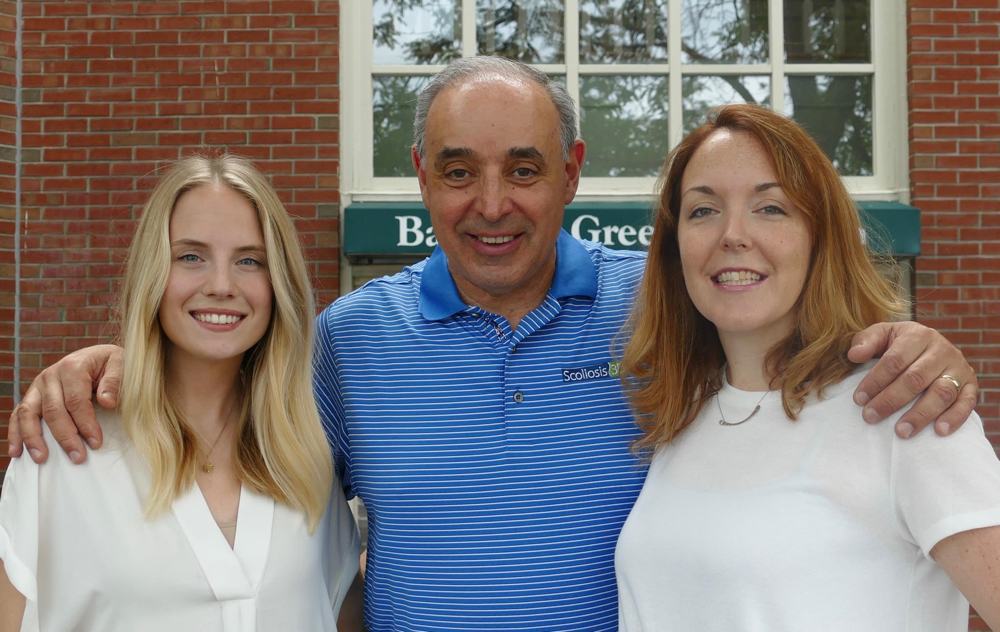
Welcome. If you’re reading this you’re probably searching for the best scoliosis treatment options for your child, yourself or someone you care about. You’re in the right place. Dr. Moramarco doesn’t just treat scoliosis, he is the father of a daughter with idiopathic scoliosis, has lived the concerns you are experiencing and is passionate about helping patients!
At Scoliosis 3DC®, we offer the very best non-surgical treatment options for scoliosis. This includes the most effective and comprehensive Schroth method therapy as well as the Gensingen Brace – a Cheneau scoliosis brace with a reported success rate of 92.9%!† Whether your goal is proactive scoliosis treatment, ongoing scoliosis management or finding a way to help your child avoid spinal fusion surgery for a worsening scoliosis, we can help! We educate, enable and empower patients, and their families. Our team takes pride in offering the best in conservative scoliosis treatment, full-time. Patients come to us for scoliosis help from around the globe and from nearly every state in the US. Please take a look at some of our results and give us a call to learn more!
The Schroth method incorporates specific scoliosis exercises in conjunction with asymmetric corrective breathing with the aim of strengthening, stabilizing or improving the spine. Exercises are tailored to a patient’s unique curve pattern. It’s a 3-dimensional approach that works from the inside out. We use Schroth Best Practice, a recent advancement to the Schroth method. The improvements and add-ons are evidence-based, effective, user-friendly and founded on original Schroth principles. When it comes to managing scoliosis, patients gain a critical advantage.
We also offer what we consider to be the best scoliosis brace available anywhere! The Gensingen brace is a Cheneau style TLSO that works according to the same principles as Schroth Best Practice.
Our mission is to guide families and patients, provide hope–with realistic expectations–while offering the tools and skills for the best chance of scoliosis correction. We invite you to browse through our Schroth method results. Each before and after scoliosis x-ray comparison is accompanied by a "mini case study" to supply insights into the various paths patients have taken.
If you are encouraged by the results you see, please call us or email for more information. We look forward to hearing from you!
“What an amazing experience! His program and website sounded almost too good to be true, but that lasted throughout the week.” Read More
“I think for me reducing the “look” of the rib hump and less back fatigue have been really incredible. It takes discipline of course and people have to realize that its an investment in their well being and they have to do it daily.” Read More
“I like that when I wear my brace Schroth breathing happens, automatically.” Read More
| Phone: | (781) 938-8558 |
|---|---|
| Email: | info@scoliosis3dc.com |
This website contains general information about scoliosis and conservative
treatment methods. The information on this website and blog should not be
treated as case-specific medical advice.
† Statistic from the Journal of Physical Therapy Science: https://www.ncbi.nlm.nih.gov/pmc/articles/PMC6893157/