“The Schroth method is a scoliosis specific back school. In the treatment programme, all possibilities for postural correction, including respiration, are used in order to enable the patients to help themselves.”
– Christa Lehnert-Schroth (1992)
What is the Schroth Method?
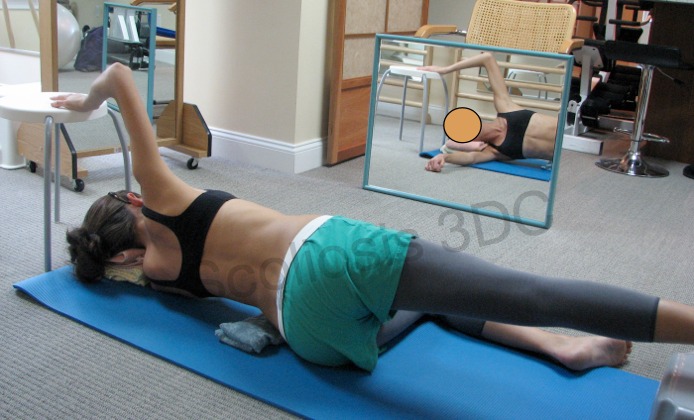
The Schroth method is a non-surgical scoliosis treatment that uses specific scoliosis exercises according to a patient’s unique spinal curve pattern. The exercises take a 3D approach to scoliosis management since they address the spine in all three anatomical planes – sagittal, frontal, and transverse. The primary goal for all patients is improved body mechanics and spinal stabilization to prevent further curve progression. For juveniles and adolescents, we strive for curve reduction (when possible) while adult treatment adds an additional focus on pain management.
The purpose of the Schroth method is to create spinal balance and stability. Through deflexion, de-rotation, and elongation of the spine and rib cage, the body is able to return to a more ‘normal’ physiological position. Schroth exercises, however, are not what you think about when you think of typical exercise.
Schroth exercises target the core and trunk, but the positioning of the entire body is taken into account to create a stable, corrected posture. While in the newly-formed posture, the patient learns to strengthen the spinal musculature via the proprietary component of the Schroth method – corrective rotational breathing – also called rotational angular breathing (RAB).
Rotational Angular Breathing
Body asymmetry caused by scoliosis creates an altered ‘scoliotic’ breathing pattern which can feed further into curvature and rotation. The muscles along the spine also become imbalanced on opposing sides. During Schroth Method instruction, the patient learns to shorten the muscles on the convex side of the spine and lengthen the muscles on the concave side. Patients also learn to change their breathing pattern to decrease the risk of curve progression. During the ‘inhalation’ phase of exercise, patients breathe into the concave side of the trunk which helps expand collapsed areas. This is followed by the ‘exhalation’ phase during which the patient isometrically contracts the muscles to strengthen and stabilize the surrounding musculature.
The basis for the use of this technique can be found in a paper entitled, “The Effect of an Exercise Program on Vital Capacity and Rib Mobility in Patients with Idiopathic Scoliosis,” (Spine, January 1991).
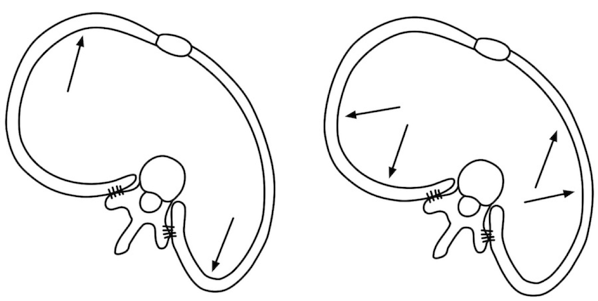
According to the conclusions of that paper, “the physiotherapy program as developed by Schroth can be regarded as highly effective for the prevention or treatment of secondary functional impairment, particularly with respect to the restrictive ventilatory disorder. It has also already been shown to have a beneficial effect on scoliosis-related pain.”
Benefits of the Schroth Method
- Cobb angle reduction (prior to skeletal maturity)
- Halted curve progression
- Spinal derotation
- Improved postural appearance
- Reduce or eliminate pain (if present)
- Spinal stabilization and better balance
- Improved lung function (FVC, FEV1, Chest Expansion)
- Improve strength and flexibility
- Empowerment over scoliosis
Note: Results vary according to the individual and are never guaranteed.
For the patient with scoliosis, the value of the Schroth method cannot be underestimated. It offers the patient the opportunity for control over a condition that most surgeons (historically the gatekeepers of scoliosis treatment) say cannot be managed without bracing, or improved without surgery.
That said, the Schroth method requires effort and mental focus. Initially, attempting to re-balance spinal musculature is no easy task. Patients must work at internalizing the concepts they’ve learned but with repetition, it becomes easier. Dedication and patience are required on the part of both the clinician and patient. As scoliosis can present differently in each affected person. Schroth programs are designed according to individual curve pattern. Given the complexity of scoliosis, Schroth instruction can be quite nuanced and practitioner experience is of great importance.
Another key to successfully treating scoliosis with curve-specific exercise is that patients must be able to practice the protocols consistently over time. With the evolution of the Schroth method and our twenty-plus years of clinical experience, during a program, we instruct patients and help them practice ways to incorporate Schroth methodology into daily life. This practice helps the patient gain an understanding and allows for better patient compliance. This way of learning makes adding the Schroth Method into life less overwhelming for the individual. Our team, Dr. Marc, Amy and Kim, are all dedicated to patient care which is custom-created to be most appropriate for each patient.
Scoliosis Exercise and Bracing
At Scoliosis 3DC®, we take the Schroth method to the next level. Our program is modeled after the German immersive-style training. Aside from being comprehensive and efficient, our intensive instructional program offers other benefits as well. The patient is less likely to be confused than traditional Schroth programs. This may be especially true for adolescents who grasp the big picture more easily when concepts are introduced, learned, and repeated over a short period of time. Of great significance, especially for adolescents learning Schroth techniques is that they can gain the skills needed before too much growth (a time of potential progression) occurs. When it comes to scoliosis treatment for adolescent scoliosis, time is of the essence!
For patients needing a back brace for scoliosis, we also offer the latest in Chêneau bracing, an asymmetric brace that is fully compatible with Schroth method principles. For those wanting a brace that offers more mobility, families can consider the Whisper Brace® and our Schroth program. We aim to offer our patients, whether child, teen, or adult the most effective opportunities to incorporate into their lives for managing scoliosis successfully.
Read more about the Scoliosis 3DC® Program
Schroth Method History
The Schroth method encompasses the work of three generations of a family dedicated to improving the lives of those with scoliosis via non-surgical treatment. In 1921, Katharina Schroth began her scoliosis program in Meissen, Germany. She treated patients with severe curvatures, often exceeding 80º. She was eventually joined by her daughter, Christa Schroth and for years, the mother daughter team worked in tandem to help scoliosis patients. Together, they established what was to become a world-renowned inpatient facility treating hundreds of scoliosis patients at a time.
Katharina Schroth
Katharina Schroth was born in 1894. As a girl she wore a scoliosis brace made of metal. She disliked the effects scoliosis had on her and she devised a way to improve her scoliosis.
Katharina’s idea for self-treatment was founded on the principle that air could be pressed out of a rubber ball. Since the depression in the ball reminded her of the concave side of her own body, she decided to begin breathing into the concavity of her torso to fill it up with air. As she practiced she observed the effects on her own physique while standing between mirrors. One discovery led to another. Katharina’s scoliosis began to lose its power as her postural appearance improved and scoliosis became manageable.
At that time, she was a teacher at a business school in Dresden. Her co-workers began noticing the postural and physical changes. She began speaking publicly about treating scoliosis through breathing and exercise. Scoliosis soon became her life’s work and legacy. Over the course of her lifetime she received numerous awards and accolades. She passed away in 1985.
Christa Lehnert-Schroth, PT
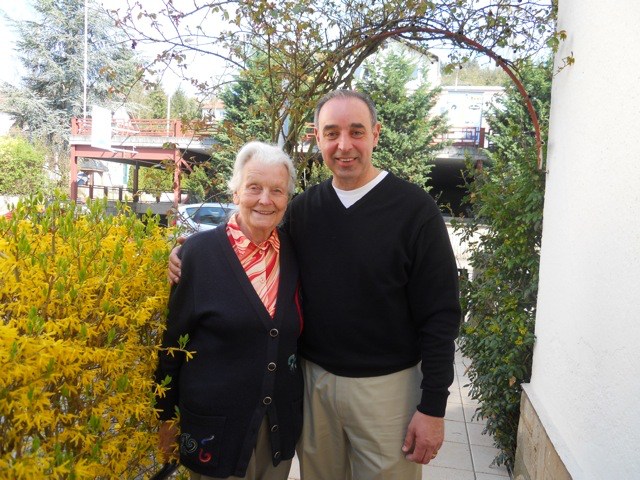
Christa Lehnert-Schroth PT, was an inspirational woman who devoted her life to the Schroth method. Frau Christa, as we knew her, dedicated her life to refining and sharing the methods her mother had created and helping scoliosis sufferers improve their posture and quality of life.
In the 1940s, Frau Christa became a PT and helped Katharina advance the Schroth method techniques. She eventually added important curve classifications for treatment. She was devoted to helping those with scoliosis and advancing the valuable Schroth techniques. Frau Christa’s career as a physical therapist spanned more than fifty years.
She worked tirelessly to spread information about the Schroth method until her death in March 2015. She was the director of the renowned Katharina Schroth Clinic, in Bad Sobernheim, Germany until 1995 when her son, Dr. Hans-Rudolf Weiss succeeded her in that role.
The inpatient clinic she and her mother established is now run by a German healthcare group and renamed the Asklepios Katharina Schroth Clinic. The Schroth family is no longer affiliated with the clinic.
In retirement, Frau Christa continued to help patients and extol the benefits of the the Schroth method. She authored the text Three Dimensional Treatment for Scoliosis: A Physiotherapeutic Method for Deformities of the Spine. That guide for practitioners has been translated into numerous languages. Just before her death, we had the privilege of collaborating with Frau Christa and her son on a new book entitled Schroth Therapy – Advancements in Conservative Scoliosis Treatment – also published in several languages.
For a more extensive Schroth method history, follow this link: https://www.ncbi.nlm.nih.gov/pmc/articles/PMC5759207/
The treatment options offered at Scoliosis 3DC® are comprehensive, outpatient Schroth method programs for those with mild, moderate or severe scoliosis. For more information, please select your area of interest below.